
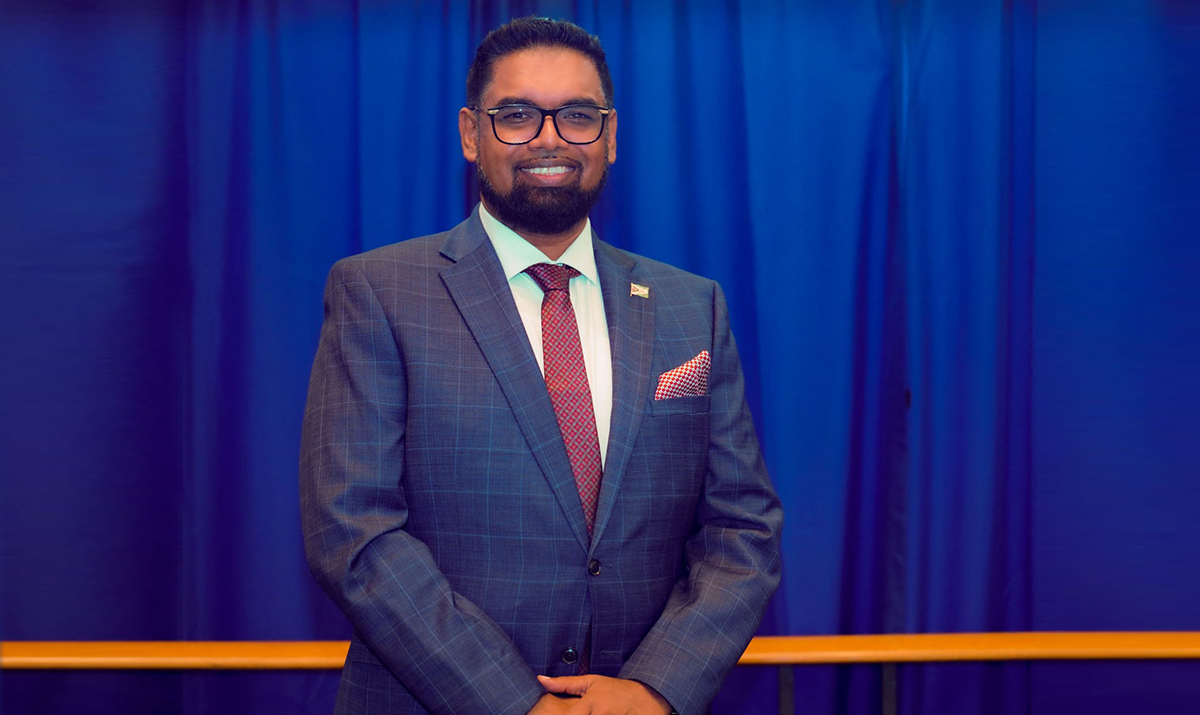
13 Apr Intreview with H. E. President Irfaan Ali, Cooperative Republic of Guyana
BF: The statistics that have grabbed global attention concern growth: the past performance as recorded by your own central bank, but also the World Bank and the IMF, and the future projections for GDP growth in Guyana. With such a level of rapid growth we have seen in the past, what are the challenges of growing at such a fast pace and how are you managing those challenges?
Irfaan Ali: First of all, there are challenges and there are opportunities. There are opportunities to develop human resource capacity, there are opportunities to advance development at a much more rapid pace. I would like to focus a lot on opportunities. Challenges are there to find solutions. What is life without challenge? It is very boring.
How do we convert a challenge into an opportunity? One of the challenges about rapid development and transformation is bringing human resource capacity to a point that it can meet the requirements of that transformation; this challenge is converted into an opportunity.
This challenge brings with it much needed revenue. We can now train 20,000 Guyanese, give them the scholarships to go and study in areas that are critical for the future of the country. Another challenge is pushing forward the agenda of developing a state-of-the-art, world class training institution that will cost more than $100 million, that will train our human resources, not only for the oil and gas sector, but in all the spinoff sectors that will come our way. In addition to that, this challenge now gives us the opportunity to build a state-of-the-art world class hospitality training center. This is a result of the rapid increase in hotel rooms, as there are more than seven new hotels under construction. That is the growth that is coming as a result of oil and gas. How do we respond? We are building the institution in the country to train more than 6,000 people that will be absorbed into this new emerging sector.
One of the other challenges met with high growth is that you must ensure your expenditure, the government expenditure. You do not want to borrow locally to finance the big transformative project and suck up the liquidity in the system and then carry up the price of borrowing for the private sector. What we are focused on for the transformative project is bringing in new capital. That is why our project portfolio is the most diversified in the whole world. We have UK financing, we have Austrian financing, we have Canadian financing, we have U.S. financing, we have Chinese financing. Our portfolio is being fueled by many different markets and that is a transformative portfolio. On private capital, we are not crowding out the private sector.
But as a result of rapid growth and expenditure, you can have overheating. We are carefully managing the situation so that there is no overheating. We are already faced with a global situation where inflation is fueled by a global crisis, and we are importing that inflation. This, we are carefully managing the pace at which we are implementing. We can implement much more transformative projects now but want to avoid overheating: we must pace ourselves. That’s the third issue.
The fourth issue is that many countries, when they get this type of revenue, immediately increase their expenditure. You hire more people in the public services to go on salary scales that are not sustainable. Although our capital expenditure is growing at such a rapid pace, our current expenditure is kept in check. Once the current expenditure comes into the system, you have to sustain it for the future, because that is the cost of keeping government going. We are managing current expenditure, which is critical. That is another important issue.
The other important thing is that, in our social safety net program, we are very incremental. Now one will say you can just try to make a political decision to gain popularity, increase everything by 100 %. But if you do that, you’re destroying the future of the country. So, we are now incrementally developing our social safety net, dealing with the children, the elderly, the vulnerable in a very incremental way.
We’re not after short-term success or short-term glory. We are building a country, an economy that will be sustainable, competitive, flexible and agile worldwide. The next seven years is about investing in those things, those areas that will allow Guyana to be one of the strongest economies in the world.
BF: Another recent success is the hosting of the International Energy Conference in Guyana, an important milestone for the country again as it just exposed the country on the map in the energy industry. In terms of the energy industry here, it underpins most of the initiatives that you’re discussing. For those to be able to be rolled out, that sector needs to continue. What is your outlook for the next 10 years for that sector?
Irfaan Ali: The sector is speaking for itself in the sense of what the results will be. We are hoping that more exploration will bring more positive results. But our energy sector and energy mix are far different. We are looking to build a world-class energy sector. One that will have renewable as an important part of it, one that will build national security in terms of what our energy needs will be, but one that will be regional in scope.
The first phase of the gas to shore project is to bring reliable, affordable electricity to the homes of Guyanese, for every family. The focus is to cut the cost of power here by 50% in the next two years. That will now allow us to be competitive for industrial development and manufacturing. We can become a major player in manufacturing and industrial development.
BF: Is that linked to the EXIM Bank, the Export Import Bank?
Irfaan Ali: That is where we apply for financing for that. Outside of that, we want to build an energy corridor because, with the investment in hydro, we’re already having interest from Brazilian companies and others to build a hydro plant that is not only for the local market, but that feeds back into northern Brazil. That’s an important part of it.
The third thought is with additional gas that is coming on stream. We have the capacity to participate in the regional energy hub that starts from French Guyana, Surinam, Guyana, and Northern Brazil. This is another area: how do we use the energy potential of the country as a major provider for regional energy, but, more importantly, develop an ecosystem around this energy hub that brings in new revenue, that creates new sectors, and that positions us as a major player in terms of the energy market. That is not even talking about all the associated gas that will come with the natural gas that is coming and the potential that will have in building up new plants, new facilities. The energy sector is separate from petroleum. The energy sector itself has enormous possibilities and we are building out an ecosystem and infrastructure to make those possibilities a reality.
We’re working with Rwanda; we’re working with India. We’re trying to accelerate our development using best practice technology. We are working on a new set of legislation that will support new industries. For example, we want to develop a legislation for data. Data business is a new area in a world with data centers. This is all new. This is what we want to do. This is where we want to put the country.
BF: Are you finding difficulties in also bringing people on board with you?
Irfaan Ali: One of the missions is to bring the ordinary people along, bring all of Guyana along, to this vision. That is why we are pursuing the one Guyana agenda, an agenda that seeks not only to bring financial benefit, economic benefit, and social benefit, but an agenda that seeks to change the mindset and the thinking, where the people understand that the possibilities of the nation are not short term. Many political actors will find it very convenient to say, why we don’t give a million dollars to every family. That is short term thinking. That is idiotic.
What we have to do is to educate the population and do immediate things to create a future that is strong and sustainable, a future that is not built on oil, but one that is fueled by the revenue from oil, one that ushers a diversified economy that is built on the revenues of oil and gas. That is why we’re focusing so hard on energy security, climate security, and food security. We want to become a major hub in terms of food security.
We started two years ago from zero production of corn and soy as input for feed production. Because of the vision, by 2025 we will be self-sufficient in corn and soy for all our people, and we will be able to export. We are doing the same thing for agro processing. We want to do the same thing for the dairy industry; there are tens of millions of U.S. dollars being invested by private sector in the dairy industry. This is our focus. When we talk about climate services, it’s not only the carbon market: there is the biodiversity services, ecological services, the value of our forests in terms of pharmaceuticals. This is all the multi-faceted development that will come out.
BF: In terms of the regional development role that you’re playing with hosting CARICOM. How does the U.S. fit into that?
Irfaan Ali: The U.S. is a very important strategic partner for us. We have been developing a very strong relationship with the U.S. We share common values and democracy and the rule of law, which is important for us. We want to embrace countries that value democracy, value the rule of law, and respect fundamental rights of people. Those are things that we value highly as a country and as a government.
The U.S. private sector is participating in a major way in the transformation that is taking place in our country. Exxon: one of our largest transformative project gas to shore projects will be done by a U.S. company, and will most likely be financed from the US EXIM Bank. Our partnership with the U.S. goes beyond geography; it is geography in nature, it is political in nature, it is economic in nature, it is business in nature, and it is good governance in nature. The relationship is a holistic pot in which we support each other. We support the development aspirations; we respect the development aspirations. That relationship is getting stronger, and it is important, especially in the region we’re in. We value the relationship highly.
BF: You have a broad strategy; you have the ingredients for a long-term sustainable economic growth miracle. Investors looking from the outside will be analyzing. How would you address concerns about the political risk profile and investor perceptions that have maybe been formed in the past?
Irfaan Ali: The political risk profile is there in every country. Even if you look at the U.S. after the last elections and you judge the country by that one event. Every single country has gone through some amount of turbulence in their histories. Unfortunately, in the last election, we had some actors who are undemocratic; they don’t respect the rule of law by nature, and they decided to try to show their undemocratic values. There’s no value in being undemocratic, but for them there is a value, and that value is power at any cost.
But the world exposed them. We have a very open society, a very transparent society, and we have different people coming with different agendas. In life you have to understand that humans have agendas, and that there are people who, under the guise that they’re the greatest environmentalists in the world, would come to the country with an agenda to, in their head, expose you on climate credentials. But where were these very people? I keep asking this one question. When this country kept this forest the size of England and kept it in such a way that it is a lung of the world, with the lowest deforestation rate in the world, storing 19.5 gigatons of carbon, they didn’t even know Guyana existed. But from the time the country prospers, and we have an opportunity to transform, they all come with an agenda. I’m OK with that because I know that that’s how they operate.
You look at the facts about the country. You look at the plans and the agenda of the government going forward. And if you look at our agenda, our plans, what we want to achieve, then any investor would be excited. We are receiving that excitement; we are receiving investors every single day from all around the world. That has occurred because Guyana is repositioning itself in a global environment in which there is great confidence in our economy.
BF: What is your final message to the readers?
Irfaan Ali: Guyana is a country that is defining itself as a functional, competitive, flexible economy in the world of 2030 and beyond. In doing so, we are making the investment to present Guyana as a global leader in energy security, food security and climate security. And we are using the revenue from oil to fuel this development.