
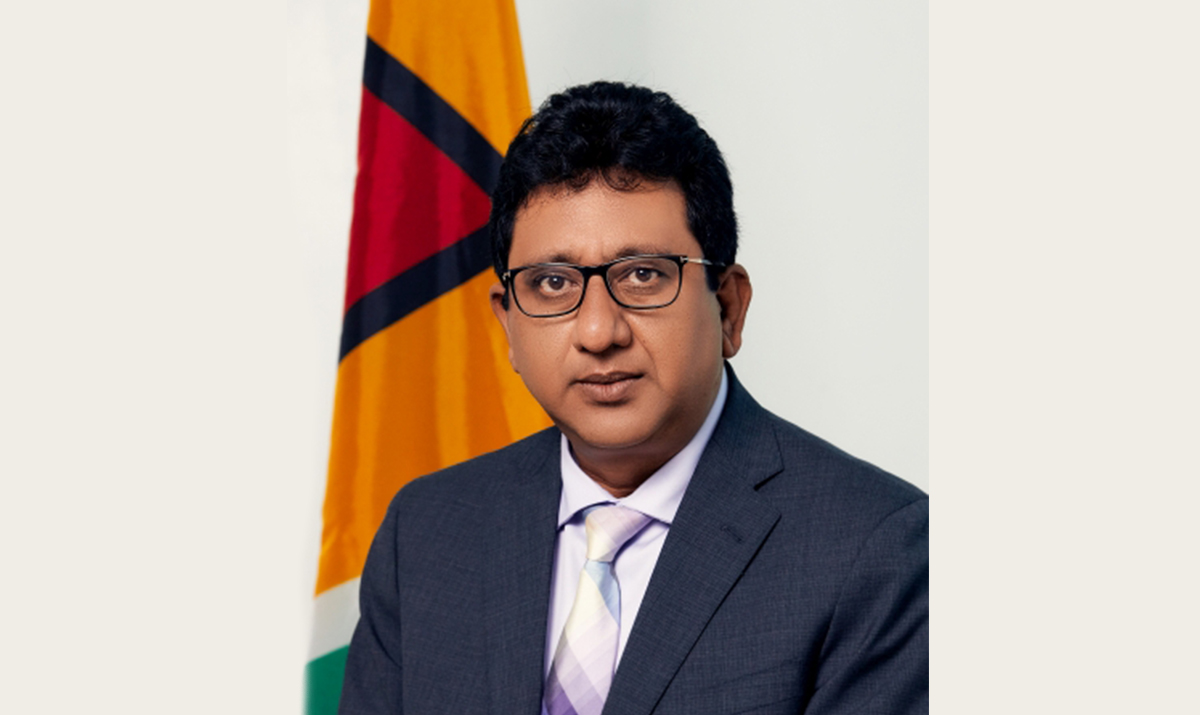
12 Apr Interview with Mohabir Anil Nandlall, Attorney General & Minister of Legal Affairs, Guyana
BF: What makes Guyana´s economy unique?
Mohabir Anil Nandlall: Guyana is currently one of the most sought after investment destinations in the Western Hemisphere. It is in a very difficult international economic environment, and we are one of the fastest, if not the fastest, growing economy on the planet. We have recently discovered one of the largest deposits of oil in the Western Hemisphere. In addition to that, we are blessed with an abundance of natural resources: gold, diamonds, bauxite, and iron ore. We have a vast number of mines and reserves. We have a large expanse of arable, very fertile agricultural lands. We have predictable climatic conditions with no known adverse disasters. We are part of the Amazonian jungle forest. We have the largest untouched forest reserves on the planet; so much so that we have been internationally recognized for the pristine state of our forest. Our forest has been described as the world’s largest air conditioning unit, providing valuable carbon credits. We are now trading in carbon credits on the international market, and we are earning millions of U.S. dollars annually. We are currently the leading carbon credit trader on the market. We are working in the Caribbean to bring food security to the region, and we can feed most of the Caribbean. The Caribbean imports approximately $10 billion of food. We can, at a minimum, easily supply more than 25% of that immediately, and we can expand and cover that entire market.
BF: What are some of the challenges facing Guyana and how are you overcoming them?
Mohabir Anil Nandlall: First of all, we came from a history of political turmoil and a lack of democracy in the country, which led to economic stagnation, social liberation, and infrastructural degradation. We had to build from ground zero, and that’s what we are doing now. We inherit our legal system from the United Kingdom. We gained independence on the May 23, 1966. Then we became a republic on February 23, 1970, but the dream of freedom and aspirations that the Guyanese of that generation were committed to and expected did not occur because we had internal political problems. One party that’s still in the opposition today rigged elections for 28 years, stole power, and remained in government, imposing themselves on the population. That led to massive migration. That’s why Guyana has one of the largest diasporas in the world per capita. We have a population of just under 800,000 people and we have about 800,000 people living outside of Guyana. We are now working to correct that hemorrhage. Some of our most strategic investment partners are in the diaspora, which is located all over the Caribbean, South America, England, and across Europe.
We are now establishing trade relations with several countries across the globe; particularly countries in the Middle East and Asia. We feel that if we can partner with those giants, it would enable us to accelerate our development. We have been left behind for decades and therefore we can’t pursue traditional methods. We must think outside of the box and move outside of the box. That is where my ministry becomes so crucial, because it’s my ministry that has to create the legal framework and the legal infrastructure that will cradle all the phenomenal and transformational development taking place in every sector of our country.
In the health sector, we must create a modern legal environment for us to install and implement partnerships with international medical institutions, such as Mount Sinai in the United States. But they’re not going to come here unless we have a certain legal infrastructure in place, so I must enact this. In the financial sector, my mandate is to create a modern financial environment, taking into account the fact that we have never had commercial activities of this magnitude. We have had to take a second look at the banking sector to relax the conventional structures that affect commercial transactions taking place. We have some very antiquated concepts in the system. We must demolish all of that and open the economy by passing the necessary laws permitting commercial institutions to function with greater freedom.
Furthermore, we must protect our local patrimony. If we allow huge companies to come into the country unregulated, then the local people will suffer. We have a content policy and legislation that protects local companies and allows them fair advantages or fair opportunities to participate in the competitive environment. We must also restructure the insurance sector to ensure we have the framework to bring in large insurance companies. We used to operate at a very small level but now insurance runs into billions of U.S. dollars, which required large international companies. To get those companies to come here, you have to have the correct legal framework. I can go sector by sector to tell you how we are building it out, but, in essence, growth begins with the establishment of a legal environment. Modern civilization is based upon law. No development can take place if the legal infrastructure that will conduce to that development is not installed. In any country where law and order are absent, or where there is a weak legal system, there will not be economic buoyancy and prosperity.
BF: Looking back at Guyana´s history, how has the outlook for Guyana changed?
Mohabir Anil Nandlall: I feel blessed to be born and be alive during this period of Guyana’s history. What Guyana is experiencing now and what Guyanese have an opportunity to benefit from is a result of centuries of sacrifices made by our foreparents. Guyana became known to the world 500 years ago through the search for a mythical golden city called El Dorado. Christopher Columbus and Sir Walter Raleigh came here in search of this mythical golden city. The legend of that golden city still lives on, and now we have an opportunity of realizing this El Dorado. I am fortunate to be part of that generation that is going to benefit from it. I am blessed, more so, to have an opportunity to be part of the leadership of the country that is pioneering these initiatives to bring broader prosperity to the entire nation. I am humbled by the opportunity that I’ve been given in this regard. We all are a team, headed by president, and I hope that we do justice to the opportunities that we have been presented with and that we create the type of tomorrow that future generations are entitled to.
BF: What is your proudest achievement since taking office?
Mohabir Anil Nandlall: I can say, with the greatest of modesty, that I am transforming the legislative landscape and the legal sector of Guyana. It is a work in progress. In the last year alone, we passed over 60 pieces of legislation, 80% of which were new modern pieces of legislation not yet passed in this region; for example, the local content law, the medical health law, and the tissue and body transplant law. I’m also working on an arbitration bill that’s going to be the most modern of its type. The natural resource law is set up for a sovereign wealth fund, which has never been done in the Caribbean. On top of this, I revolutionized the law of bail, where citizens can now get bail when they’re charged. I have brought a regime of new laws concerning drinking and driving, where you can now be charged with human manslaughter if you drive and cause death, whereas before it was an ordinary offense. This has led to a reduction in offenses and greater accountability. Traffic offenses are a very big problem in this country, and I aim to address that. Finally, we had the common law of England applying here, which is centuries old. We passed a higher purchase law that protects the customer to a greater extent when they buy goods on credit. Before if you paid 90% and defaulted one payment, the seller could come and seize the goods and forfeit all your payments up until that point. Our new law provides more protective mechanisms to consumers.
BF: What is your background? How did you garner the experience to take on this role?
Mohabir Anil Nandlall: I’ve worked in the legal system of Guyana since I was a teenager. Then I became a lawyer in private practice. I had one of the largest and most successful practices in Guyana. I was attorney general a few years ago. All these years gave me a wealth of experience. I’m also a businessman and own a telecommunication building that I designed myself.
BF: What is your personal message to the readers of USA Today?
Mohabir Anil Nandlall: I want them to know that Guyana is the undiscovered paradise of the world. So far it has been the world’s best-kept secret. It has a tourism product that is unrivalled and different from the rest of the Caribbean. When people think about the Caribbean, they think about blue waters and white sand. We offer something different. We offer ecotourism. We offer nature in its most pristine form. We offer thousands of species of animals, fauna and flora in their most natural habitat. We offer the serenity and tranquility of nature. We have the highest single-drop waterfall on the planet. Alongside all this, we can also give you what the modern world offers.